
Battery-Law-Notices
Some of our products contain batteries or rechargeable batteries, or are supplied with them – for example test equipment, kits and accessories. As a retailer, we are required under the German Battery Law Implementation Act (Batterierecht-Durchführungsgesetz, BattDG) to inform you of the following.
Used batteries do not belong in household waste
Batteries and rechargeable batteries must not be disposed of with household waste. As an end user, you are legally obliged to return used batteries separately from household waste. Where batteries are built into or supplied with other products, please remove them before disposing of the product, provided this can be done without destroying it.
Where you can return used batteries
You can return used batteries and rechargeable batteries of the types we sell free of charge to our dispatch warehouse – in person or by post to the address shown on this page. For lithium batteries and rechargeable batteries, please tape over the terminals before posting to prevent short circuits, and pack the batteries so they cannot touch each other.
You can also hand in used batteries free of charge at municipal collection points (recycling centres, hazardous waste collections) and anywhere batteries are sold – in Germany, shops provide collection boxes near the checkout. This is usually the shorter route than posting them to us. Outside Germany, please use the collection points available in your country.
What the marking means
The crossed-out wheeled bin on batteries and rechargeable batteries means they must not be disposed of with household waste. If a battery contains hazardous substances above the legal limits, the chemical symbol of the heavy metal appears below the symbol:
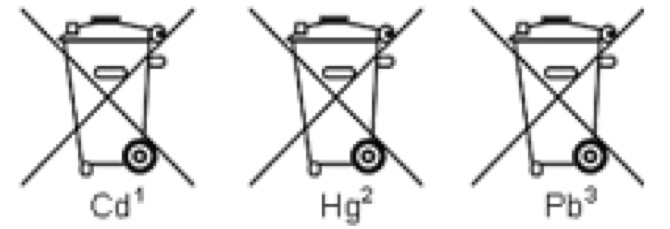
| Cd | Cadmium – the battery contains more than 0.002 % cadmium by weight. |
|---|---|
| Hg | Mercury – the battery contains more than 0.0005 % mercury by weight. |
| Pb | Lead – the battery contains more than 0.004 % lead by weight. |
Why separate collection matters
Batteries contain substances that can harm the environment and human health if disposed of improperly – heavy metals such as cadmium, lead and mercury, but also electrolytes and lithium. When batteries are collected separately, these substances can be treated properly, and valuable raw materials such as nickel, cobalt, copper and lithium are recovered instead of being lost in residual waste. Carelessly discarded batteries also pollute soil and water.
Take particular care with lithium batteries
Lithium batteries and rechargeable batteries – for example in radios, test equipment and power banks – can catch fire if damaged, short-circuited, overheated or deeply discharged. Do not keep damaged or swollen batteries in your home and never put them in household waste; they are a frequent cause of fires in refuse vehicles and sorting plants. Tape over the terminals and take them to a collection point promptly.
Avoid waste, use batteries longer
The most environmentally friendly battery is the one that never needs disposing of. Wherever possible, rechargeable batteries are the better choice over single-use batteries. Store rechargeable batteries in a cool place at a medium state of charge, avoid deep discharge and use a suitable charger – they will last considerably longer. Rechargeable batteries that still work do not need to be disposed of; they can often be reused in other devices or prepared for reuse.
This information fulfils our duty to inform under Section 24 BattDG in conjunction with Article 74 of the EU Batteries Regulation (EU) 2023/1542.
Returns to our dispatch warehouse
DARC Verlag GmbH
– Battery returns –
Lindenallee 6
34225 Baunatal
Germany
Returns are free of charge. If you post them, you pay the postage; tape over the terminals and pack batteries individually. Please check your carrier's rules for posting lithium batteries.
At a glance
- Household waste
- no, never
- Returns
- collection points, retailers, our dispatch warehouse – free of charge
- Lithium batteries
- tape over the terminals, hand in damaged batteries promptly
